The Ecology of Command and Control - A Theological and Tactical Survey of Proprietary, Open-Source, and Experimental C2s
⚠️ Ethical & Legal Disclaimer: Wisdom Governs Knowledge
⚠️ The infrastructure, code, and methodologies described in this blog are designed solely for lawful, educational, and ethical purposes. This series is intended to help red team professionals, security researchers, and students build controlled environments for testing, training, and strengthening defensive postures.
As those made in the image of God and called to walk in integrity, we affirm that knowledge must be governed by wisdom. The Apostle Paul reminds us, “All things are lawful, but not all things are helpful”_ (1 Cor. 10:23). Accordingly, these tools are not to be used for harm, unauthorized access, or malicious activity of any kind.
Let it be clear: this work is to be conducted with a clear conscience before both God and man (Acts 24:16). Those who weaponize such knowledge outside the bounds of legality and virtue not only violate human law, but grieve the moral law of the Creator Himself.
“Whatever you do, in word or deed, do everything in the name of the Lord Jesus…”
— Colossians 3:17
The Ecology of Command-and-Control: A Theological and Tactical Survey
“Examine everything; hold fast what is good.”
— 1 Thessalonians 5:21
“For nothing is hidden that will not become evident.”
— Luke 8:17
Introduction

Modern Command-and-Control (C2) frameworks are more than just tactical toolkits; they represent distinct operational philosophies, development ecosystems, and strategic challenges for both Red Teams and Defenders. Like biological or ecclesial structures, these frameworks — spanning from polished commercial products to chaotic, open-source projects, and stealthy, platform-native techniques — form a complex ecology that constantly evolves the cyber landscape.
This three-part series undertakes a dual examination of modern C2s. We survey the tactical realities of proprietary, open-source, and experimental C2s, while simultaneously engaging their theological resonance. Each framework class serves as a parable for concepts like centralized power, stewardship, reformation, and the profound nature of providence and hiddenness in the digital domain.
Series Structure
- Part I — Proprietary C2s Focus: Reliability, centralization, and the burden of Stewardship.
- Part II — Open-Source C2s Focus: Innovation, fragmentation, and the echoes of Reformation.
- Part III — Experimental C2s Focus: Stealth, ordinariness, and the subtlety of Providence.
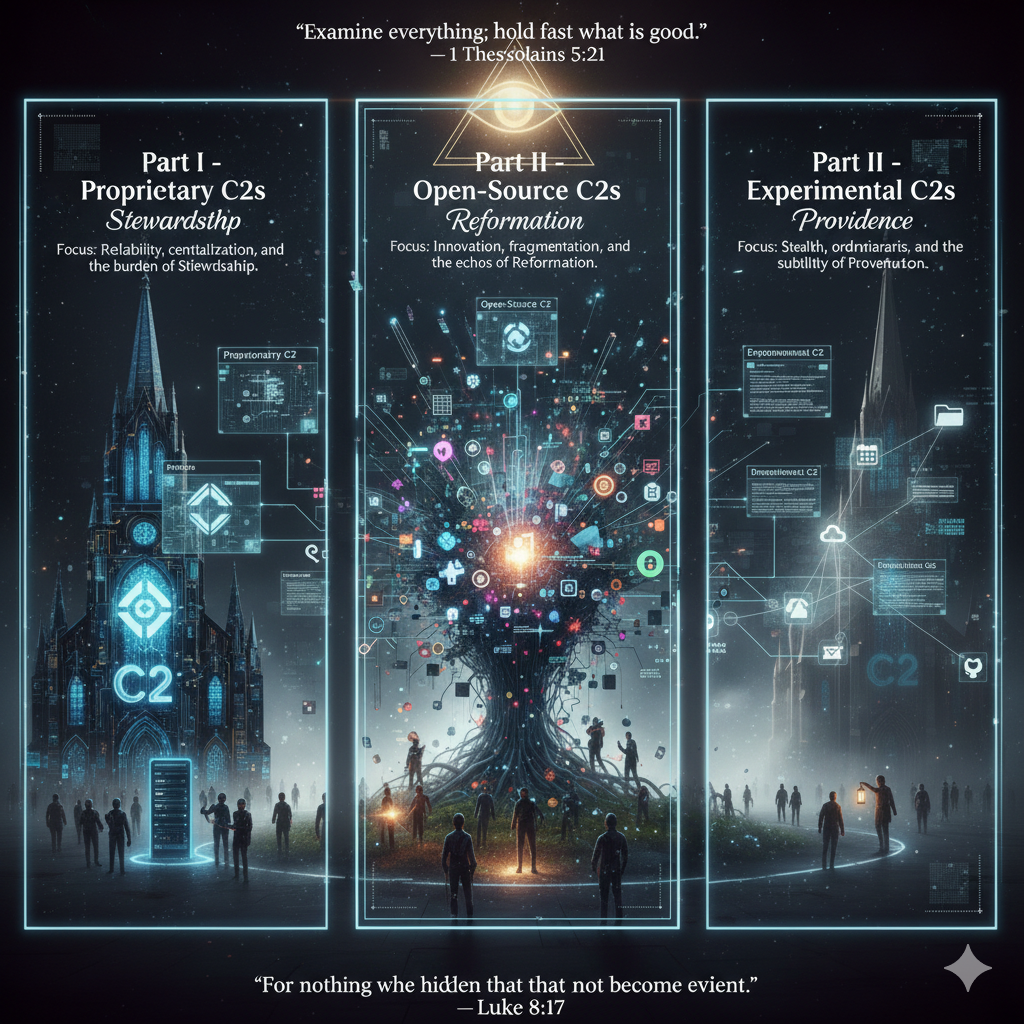
Part I — Proprietary C2s: The Established Order

Representative tools: Cobalt Strike, Stage 1, Brute Ratel (commercial offerings)
Overview
Proprietary C2s established the gold standard for operator workflows. They offer mature, centralized platforms that define the “Beacon” model and provide professional ecosystems essential for large-scale, coordinated red team operations.
Strengths
- Polished UX and operator ergonomics
- Well-documented tradecraft and community best practices
- Built-in teamwork and collaboration features
- Commercial support and stable release cycles
Weaknesses
- Predictable Artifacts: Signature hunting targets them first; artifacts are canonical and well-known.
- Access Barriers: High cost and licensing restrict widespread access (concentrated power).
- Adaptation Lag: Slower response time when defenders implement new telemetry models.
Operational impact
Proprietary C2s lower friction for mature teams and enable complex multi-operator campaigns. They serve as a baseline: many blue teams calibrate detections to these tools first.
Defensive implications
Signatures and telemetry soup often begin here. Defenders will detect and harden against the canonical patterns long before oddballs emerge.
A Theological Frame
Proprietary C2s resemble established, centralized ecclesial structures (think institutional church). They are powerful, ordered, and sacramental in their professional function. They illustrate the concept of Stewardship (cf. Luke 12:48: “To whom much is given, much will be required”). The concentration of access and power demands greater moral accountability, not only from the operators but also from the vendor whose tool may be misused by adversaries, raising questions about the ethics of dual-use technology. Their calcification or predictable patterns can expose the need for disruptive reform.
Summary of Part I
Because these tools were so visible and reusable, they catalyzed the community’s search for alternatives — sparking the growth of open-source and experimental C2 ecosystems.
Part II — Open-Source C2s: The Age of Reformation
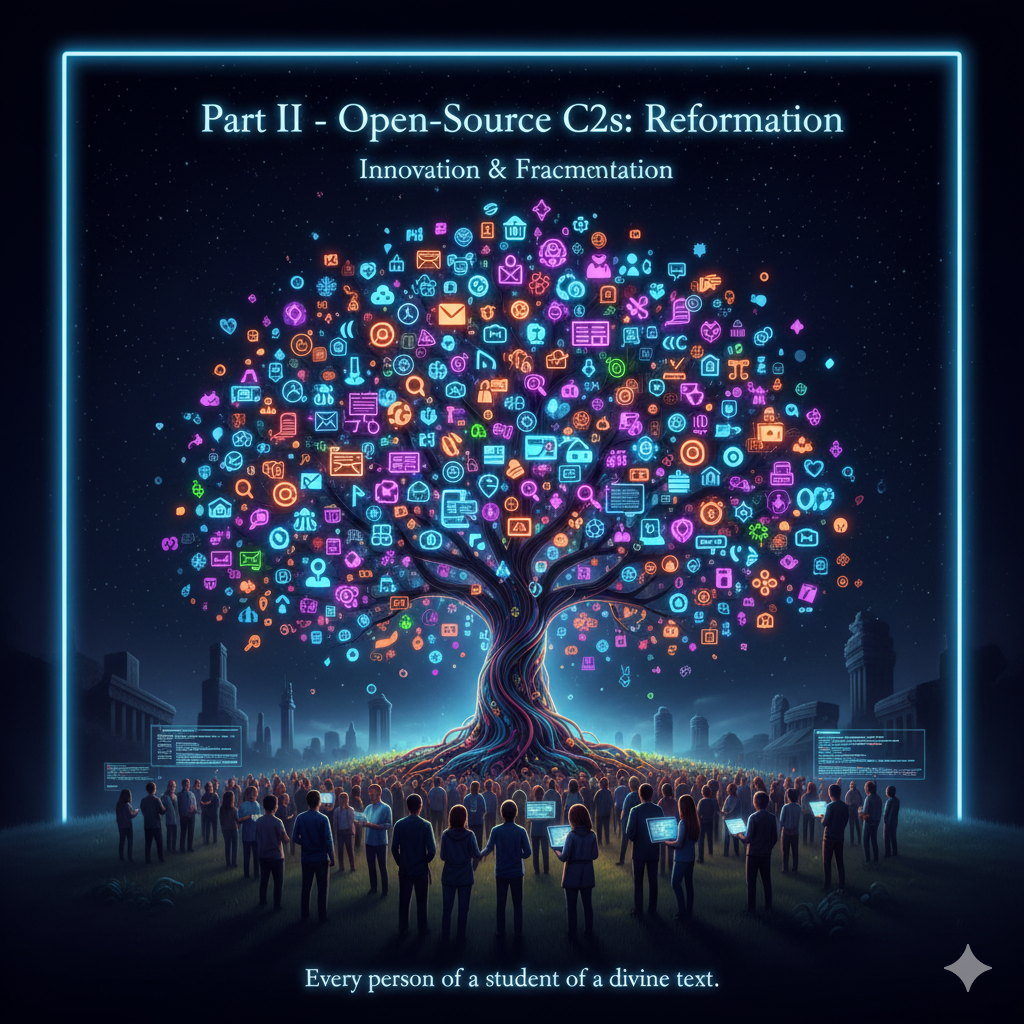
Representative tools: Sliver, Mythic, Adaptix, Havoc, Merlin, Covenant, others
Overview
Open-source C2s democratized development, inviting community contributions and rapid, polyglot iteration. They multiply innovative ideas quickly, lowering the barrier to entry for novel and niche tradecraft.
Strengths
- Rapid innovation and modularity
- Community auditing and transparency of code
- Flexible architectures (polyglot agents, containerized controllers)
- Easy extensibility for research and custom operations
Weaknesses
- Fragmentation: Inconsistent quality, maintenance, and documentation across the ecosystem.
- Complexity: Steeper learning curves and more operational overhead required for deployment.
- Maturity Gap: May lack the polish and stability of commercial, tested platforms.
Operational impact
Open-source C2s let teams prototype new evasion techniques, compose hybrid tooling stacks, and tailor agents to niche missions. They raise the skill floor and create specialized tool ecosystems.
Defensive implications
The variety forces defenders to move beyond static signatures toward behavior and baseline anomaly detection. The proliferation increases noise for defenders, requiring telemetry normalization and threat-informed detection strategies.
Another Theological Frame
Open-source C2s perfectly echo the Reformation impulse: a decentralization of authority, a proliferation of texts and interpretations, and the concept of semper reformanda (always reforming). They embody the “priesthood of all practitioners,” where any skilled individual can contribute, audit, and fork the code. This distribution exposes centralized failures but introduces new challenges of order, unity, and truth (cf. 1 Corinthians 12). This creative chaos compels the security industry toward continuous improvement and away from reliance on a single, canonical “truth.”
Summary of Part II
Open-source diversity fuels experimentation and accelerates both offense and defense. The community becomes a primary engine of innovation — for good and for disruptive complexity.
Part III — Experimental C2s: Hidden in Plain Sight

Representative techniques: C2 over Slack/Discord/Teams, GitHub commits, DNS TXT dead-drops, serverless callbacks, mailbox drafts, steganographic callbacks, WebRTC brokers, behavioral/temporal channels
Overview
Experimental C2s prioritize ordinariness over capability. They leverage legitimate platforms and common user behaviors as cover. Their true strength lies in plausible deniability—the ability to blend into the noise of normal, high-volume traffic.
Strengths
- High stealth by blending with legitimate services
- Low infrastructure footprint and high ephemerality
- Harder for signature engines to flag without raising false positives
Weaknesses
- Operational Fragility: Vulnerable to service API changes, platform policy updates, and rate limits.
- Constraint: Often limited in bandwidth, latency, and operational scope.
- Ethical Risk: Increased ethical and legal risks when leveraging public, third-party platforms.
Operational impact
These methods enable targeted, low-dwell operations and force red teams to consider human mimicry, timing, and social channel fidelity as core capabilities. They also provide pathways for red teams to simulate sophisticated adversaries more realistically.
Defensive implications
Defenders must adopt contextual, identity-aware, and behavior-centric detection. The distinction between “malicious” and “normal” behavior blurs; investigation relies on cross-correlation, threat intelligence, and risk scoring.
The Last Theological Frame
Experimental C2s are the Esther-type of techniques, operating with silent efficacy. They analogize to Providence—the idea that God works decisively through means that appear entirely ordinary and mundane, without explicit, miraculous intervention (cf. the Book of Esther, where God is never explicitly mentioned but His hand is assumed). They remind us that discernment is paramount. Detection moves from identifying the obvious “roaring lion” (1 Peter 5:8) to discerning the subtle, contextual threat hidden among benign, everyday actions (Isaiah 45:15).
Summary of Part III
The future of stealth is likely to be ordinary. Tools that mimic legitimate user behavior will compel defenders to favor contextual, identity, and behavior models — and to cultivate deeper discernment.
Series Conclusion — What This Means for Practitioners
Tactical and Theological Imperatives
For Red Teams: Cultivating Fluency
The successful operator must maintain multi-tool fluency. Proprietary C2s offer stable baselines; Open-Source C2s provide customized innovation; and Experimental C2s push the boundaries of stealth and realism. The choice of C2 is a mission-aligned act of stewardship.
For Defenders: Embracing the Behavioral Shift
The era of signature-first defense is over. The proliferation of Open-Source and Experimental C2s means that defenders must shift investment toward contextual, identity-aware, and behavior-centric detection. The goal is no longer merely to detect the tool, but to detect the malicious behavior within the normal stream of events.
For Theologians and Ethicists: A Ministry of Discernment
The cybersecurity domain offers profound lessons in ethics and theology:
- The tension between hiddenness and revelation in Luke 8:17.
- The requirement of wisdom and discernment in testing and vulnerability (1 Thessalonians 5:21).
- Red Teaming, at its best, acts as a ministry of discernment—not exploiting vulnerabilities, but exposing them under controlled conditions so that the organization can be mended and hardened.
“Be sober-minded; be watchful. Your adversary prowls around like a roaring lion…”
— 1 Peter 5:8
— AthanasiusXOR
Contra Mundum. Under Christ. On Mission.